High Maintenance: A Designer’s Take on the Quote
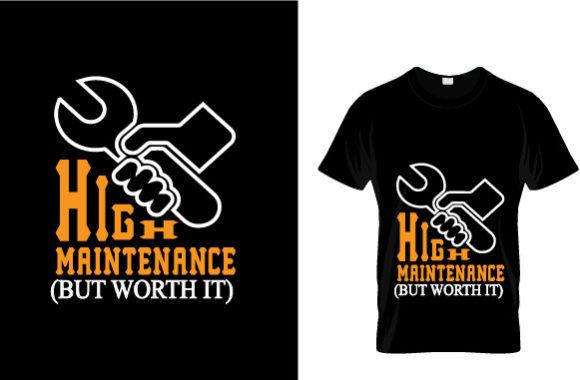
As an embroidery designer who has spent countless hours digitizing, stitching, and troubleshooting designs for clients, I approach every new machine embroidery design with a mix of curiosity and caution. We have all been there: you find a graphic that looks stunning on a screen, only to realize it turns into a tangled mess of thread breaks and puckering once it hits the hoop. That is why I took a close look at High Maintenance, a vector-based graphic featuring the popular quote "High Maintenance But Worth It." While this product is marketed primarily as a T-shirt design vector for printing, its potential in the embroidery world is worth exploring for those of us who love translating digital art into tactile, stitched reality.
First Impressions: Mood and Visual Personality
The phrase "High Maintenance But Worth It" carries a specific attitude. It is confident, slightly sassy, and unapologetically bold. Visually, the layout of High Maintenance relies heavily on typography. In my experience, text-heavy designs are tricky in embroidery because they require precise digitizing to remain legible. Since this product comes as a set of Graphics in formats like EPS, Ai, SVG, JPG, and PNG, it is not a pre-digitized embroidery file ready for your machine. Instead, it is a raw asset that requires you to do the heavy lifting—or hire a digitizer—to convert it into stitches.
This distinction is crucial. The mood of the design is modern and clean. It does not rely on complex shading or intricate illustrations, which is actually a benefit for embroidery. Simple, bold lines translate better to thread than complex gradients. When I visualize this on a project, I see it working best with a strong, sans-serif font style that holds up well under satin stitch or a dense fill stitch. The visual personality suggests it belongs on items that are meant to be seen and read from a distance, rather than subtle, delicate accents.
Real-World Application: From Vector to Stitch
Let’s talk about a real-life scenario. Imagine you are preparing a custom order for a boutique client who wants a line of branded tote bags. They love the attitude of the "High Maintenance But Worth It" quote. You have the SVG file from the High Maintenance package. Your first step is not to hit "print," but to open your digitizing software. Because this is a vector, you have full control over the node points, allowing you to optimize the pathing for your embroidery machine.
For a tote bag design, I would recommend using a heavier weight canvas. The design needs a stable foundation. If you were to attempt this on a thin, stretchy fabric without proper preparation, the text could distort. I envision this design looking fantastic on a structured embroidered patch that can then be ironed or sewn onto various garments. This approach solves many fabric compatibility issues. By creating a patch, you can use a stiff backing, ensuring the letters remain crisp and the stitch density does not cause the surrounding fabric to pucker.
Another excellent application is sweatshirt embroidery. A crewneck sweatshirt provides the perfect thick, cozy canvas for this type of bold statement. The texture of the fleece helps hide minor imperfections, and the large surface area allows the text to breathe. However, you must be mindful of the hoop size. Ensure your design fits comfortably within your machine’s maximum hoop dimensions, leaving enough margin for the frame to grip the fabric securely without crushing the nap of the fleece.
Navigating Challenges: Where to Be Careful
While High Maintenance is a strong concept, it is not without its pitfalls. The biggest challenge with quote-based designs is small lettering. If you scale the design down too much, the inner spaces of letters like 'e', 'a', or 'o' may fill in with thread, making the word unreadable. This is especially true if you are working with a running stitch outline versus a solid fill. Always test your scaled-down version on scrap fabric before committing to the final product.
Textured fabrics also pose a risk. If you are stitching this directly onto a waffle-knit towel or a ribbed knit cap, the uneven surface can cause the thread to sink or look irregular. In these cases, using a cut-away stabilizer is non-negotiable. For curved surfaces like caps, the distortion factor is high. I would advise against stitching this specific long-quote design directly onto a standard dad hat unless you have advanced digitizing skills to compensate for the pull. A flat brim or a structured front panel is safer.
Dark fabrics present another consideration. The product includes JPG and PNG files, which likely show the design in black or a single color. If you are stitching on a black hoodie, you will need to choose high-contrast thread colors like white, gold, or neon pink. However, remember that light threads on dark fabric often require an underlay stitch to prevent the background fabric from showing through. This increases the stitch density and production time, so factor that into your pricing if you are an Etsy seller or running a craft business.
Enhancing Product Value and Brand Consistency
Why choose a design like High Maintenance? Because it connects emotionally. Customers buying personalized gift items or custom apparel are often looking for something that expresses their identity. This quote appeals to someone who takes pride in their appearance or their standards. When executed well, it elevates the perceived value of the finished product. It moves the item from a generic piece of clothing to a statement piece.
For small shop product lines, consistency is key. If you use this design across a range of items—perhaps a matching set of a tote bag and a pillow cover—you create a cohesive brand aesthetic. The clean lines of the vector graphic allow for easy adaptation. You can change the thread colors to match seasonal trends, making it viable for holiday embroidery collections or year-round sales. Using the included AI and EPS files, you can also create high-quality printable mockup images for your online store, giving customers a realistic preview of how the embroidery will look before they buy.
Practical Notes for the Embroidery Designer
Before you load this design into your machine, here are my top recommendations for ensuring success:
- Digitize with Care: Since this is a vector graphic and not a pre-made digital embroidery file, you must digitize it yourself or hire a professional. Pay attention to jump stitches and trim points to keep the back of your work clean.
- Test on Scraps: Never skip the test stitch. Use the same fabric and stabilizer combination you plan to use for the final item. Check for puckering, thread breaks, and legibility.
- Check Licensing: The product description states it is perfect for printing and includes various graphic formats. It does not explicitly state commercial embroidery rights. Always confirm the license terms before selling finished items or using it in commercial embroidery projects.
- Contrast is Key: Use the black and white versions of the PNG or JPG to check contrast. If the design disappears in grayscale, it will likely lack impact when stitched.
- Stabilizer Selection: For stretchy fabrics like t-shirts, use a tear-away stabilizer with a fusible topping to prevent the stitches from sinking into the knit. For woven fabrics like tote bags, a cut-away stabilizer provides long-lasting durability.
In conclusion, High Maintenance is a versatile graphic asset that, with the right technical approach, can become a standout embroidery project. It is not a plug-and-play solution, but for the experienced designer or willing learner, it offers the flexibility to create high-quality, emotionally resonant products. Whether you are making a baby embroidery item for a friend or stocking your small shop product inventory, the key lies in respecting the material limits and honoring the boldness of the design.